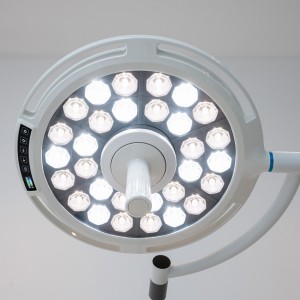
In any clinical environment—whether it is a dermatology suite, a general practice room, or a minor surgery theater—the quality of light is not just a comfort factor; it is a diagnostic tool. A misidentified tissue color or a shadow in the wrong place can change a patient’s outcome.
As a medical professional, how do you navigate the technical jargon of Lux, CRI, and Kelvin to find a light that actually supports your work? This guide breaks down the essentials and introduces why Nanchang Micare Medical Equipment Co., Ltd. has become a trusted name for clinics globally.
1. Illumination Depth and Intensity (Lux)
The first question is always: “How bright is it?” In medical terms, this is measured in Lux at a specific distance (usually 0.5m or 1.0m).
- For general exams: A range of 30,000 to 50,000 Lux is standard. Micare’s JD1000J model is a classic example, providing 50,000 Lux of focused precision, ideal for routine diagnostics.
- For minor procedures: You need more intensity. The Micare JD1700 Series pushes boundaries by delivering up to 120,000 Lux, bridging the gap between an exam light and a full surgical lamp.
Pro Tip: Look for “Stepless Dimming.” Being able to adjust brightness without flickering allows you to adapt to different skin tones and procedures without straining your eyes.
2. Color Fidelity: The CRI Factor
Color Rendering Index (CRI) measures how accurately a light source reveals the true colors of an object compared to natural sunlight. For clinicians, a high CRI is non-negotiable for identifying rashes, inflammation, or vascular changes.
Most generic LED lights offer a CRI of 80. In contrast, Micare’s high-end models like the JD1700 boast a CRI of 96+. When the CRI exceeds 95, “R9″ (saturated red) becomes much more visible, allowing surgeons and GPs to see blood and tissue with high-definition clarity.
3. Heat Management: The “Cold Light” Advantage
Old halogen bulbs were notorious for emitting heat, causing discomfort for both the patient and the doctor during long procedures. Modern LED technology should provide “Cold Light.”
Nanchang Micare integrates advanced heat-dissipation structures in their lamp heads. Even at maximum output, the temperature rise at the surgical field is kept to a minimum (typically <2°C). This thermal control not only protects sensitive tissue from drying out but also extends the LED lifespan to over 50,000 hours—virtually eliminating maintenance costs for your clinic.
4. Maneuverability and Form Factor
A great light is useless if you can’t position it where you need it. You should choose a mounting style based on your room layout:
- Mobile Floor Stand: Best for multi-purpose rooms.
- Wall Mount: Saves floor space in small exam rooms.
- Ceiling Mount: Ideal for dedicated procedure rooms where a full range of motion is required.
Micare’s JD1200 Centre Spotlight series is particularly praised for its flexible gooseneck and spring-arm designs, ensuring that once you set a position, the light stays there without “drifting.”
Why Choose Nanchang Micare Medical?
Based in the industrial hub of Jiangxi, China, Nanchang Micare Medical Equipment Co., Ltd. has spent over a decade perfecting the balance between high-end optics and affordable manufacturing. Unlike many “trading companies,” Micare is a direct manufacturer with ISO13485 and CE certifications.
Real Data at a Glance:
| Feature | JD1000J (Standard) | JD1700 (Pro/Minor Surgery) |
|---|---|---|
| Intensity (Lux) | 50,000 | 100,000 – 120,000 |
| CRI (Ra) | >90 | 96+ |
| Color Temp (K) | 4500±500 | 3800 – 5300 (Adjustable) |
| LED Life | >50,000h | >50,000h |
| Ideal For | GP, Dermatology, Gynecology | ER, Minor Surgery, Dental Implant |
The Bottom Line
Choosing the right examination light is an investment in your diagnostic accuracy. By focusing on high CRI, cool operation, and reliable intensity, you ensure your clinic operates at peak performance.
If you are looking to upgrade your facility with internationally certified, high-performance lighting, explore the full catalog at www.surgicallight.com or contact the Micare team for a customized clinical solution.
Post time: Jun-28-2026