When we talk to clinic managers and surgeons at Micare, they rarely start by asking about “lux intensity.” Instead, they talk about frustration. They talk about the surgery that went late because of eye strain, or the assistant who had to keep adjusting a lamp that wouldn’t stay in place.
If you’re in the market for a new surgical light in 2026, it’s easy to get lost in spec sheets. But after a decade in medical illumination, we’ve learned that the best light isn’t the one with the highest numbers—it’s the one that “disappears” during a procedure, allowing the surgeon to focus entirely on the patient.
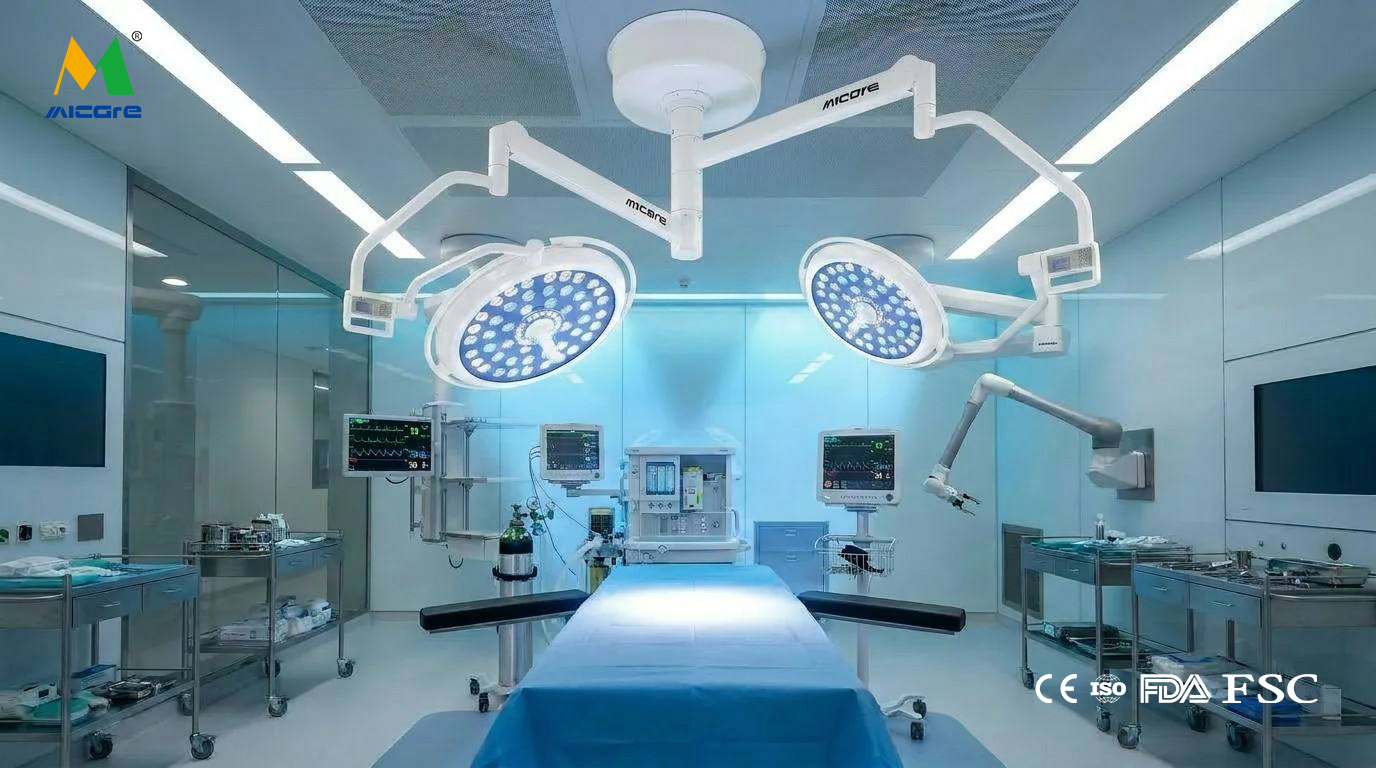
The “Shadow” Problem is Actually a Lens Problem
We’ve all seen it: a surgeon leans in, an assistant moves a hand, and suddenly, the surgical field is cast in shadow. Most generic LED lamps try to fix this by just adding more brightness. It doesn’t work.
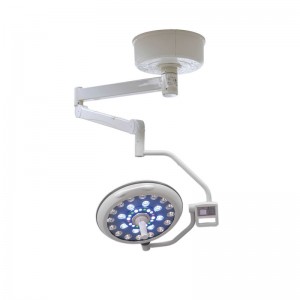
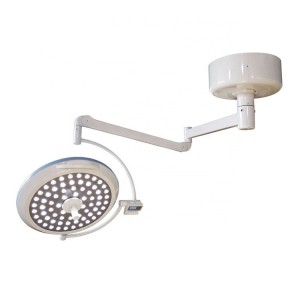
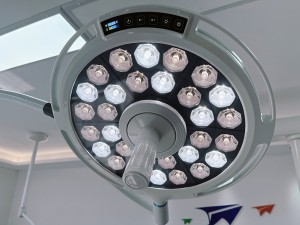
A truly shadowless operating lamp requires a sophisticated overlapping lens system. At Micare, we focus on how the light beams intersect. By using dozens of individual LED clusters, each tilted at a specific angle, we ensure that even when 50% of the light head is obstructed, the illumination on the tissue remains constant. It’s about optics, not just raw power.
Why “Red” is the Most Important Color in Surgery
Standard office LEDs are great for reading, but they are dangerous for surgery. Why? Because they often fail to render “Deep Red” (the R9 value).
In a surgical environment, being able to distinguish between a small nerve and a blood vessel is critical. If your light has a low Color Rendering Index (CRI), everything starts to look like a muddy orange-brown. We ensure our LED surgical lights maintain a CRI above 95, with a high R9 rating. When you can see the true saturated red of the anatomy, you make faster, safer decisions. It’s that simple.
Stop Sweating Under the Spotlight
One of the oldest complaints about traditional halogen lights was the heat. No one wants to perform a four-hour surgery under a giant heater.
While LEDs are “cool” by nature, the electronics inside the lamp head still generate heat. If that heat isn’t managed, the LEDs degrade, and the light starts to flicker or dim within a year. We’ve engineered our lamp heads with aerodynamically designed aluminum housings. This doesn’t just look sleek; it pulls heat away from the LEDs and the surgical field. It keeps the environment cool for the staff and protects the patient’s exposed tissue from drying out.
The Balance of Movement: The “Drift” Test
There is nothing more distracting than a light head that slowly drifts away from the site mid-surgery. This usually happens because of a cheap balance arm or poor weight calibration.
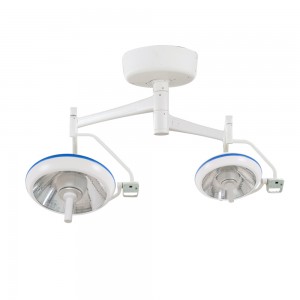
When we design Micare lighting systems, we obsess over the articulation. We use a feather-light balance arm that moves when you want it to, but stays exactly where you leave it. Whether you prefer a ceiling-mounted setup for a permanent OR or a mobile unit for your diagnostic clinic, the “feel” of the movement should be effortless.
Compliance: It’s Not Just a Label
In our industry, certifications like FDA, CE, and ISO13485 are often treated as checkboxes. But for a clinic owner, these are your safety net. They mean that every component—from the power supply to the LED chip—has been tested for medical-grade reliability.
At Micare, we don’t just ship boxes; we ship peace of mind. Our compliance with international standards is our guarantee that your light will perform as well in year five as it did on day one.
Choosing the Right Partner
At the end of the day, you aren’t just buying a lamp; you are choosing a partner for your facility’s growth. We’ve spent years listening to what surgeons actually need. Whether it’s an outpatient ENT clinic or a major hospital’s main OR, the goal is the same: clarity, reliability, and safety.
Looking for more than just a spec sheet? Drop us a message. We’d be happy to discuss your clinic’s specific layout and help you find a lighting solution that actually makes your workday easier.
View the 2026 Micare Surgical Collection
Post time: Jun-04-2026