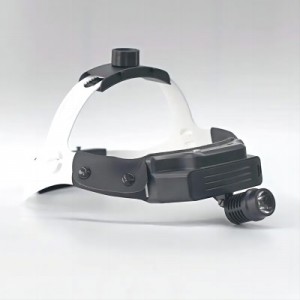
Ask any surgeon who has worn both, and the answer tends to split along the same line: the choice between a wireless surgical headlight and a wired surgical headlight is not about which one is better — it is about which trade-off fits the procedure.
Both configurations serve the same clinical demand: shadow-free, high-CRI illumination directed precisely into a narrow surgical field. The divergence lies in how each delivers sustained output across the length of a case.
The Wired Surgical Headlight: Uninterrupted Power, Fixed Anchor
A wired surgical headlight draws power directly from a mains-connected control box or a belt-worn battery pack linked by a cable. Its defining advantage is continuity. There is no runtime ceiling — the light stays on as long as the power source is live. For procedures that routinely exceed four or five hours, this alone can be the deciding factor. Neurosurgery, complex spinal reconstruction, and free-flap microsurgery are cases in point: the surgical team cannot afford a mid-procedure battery swap, and no one wants to factor illumination logistics into an already demanding workflow.
The counterweight is the tether. The cable — typically running from the headband down the surgeon’s back to a belt pack or draped across the sterile field to a floor unit — introduces a physical constraint. In disciplines where the surgeon rotates around the patient frequently, or where multiple team members share a single light source, the cable demands conscious management. Over a long operating list, minor re-routing of the cord accumulates into a non-trivial ergonomic burden.
From a performance standpoint, wired LED surgical headlights tend to sustain peak brightness without throttling, since thermal management and power delivery are unconstrained by battery chemistry. This makes them a natural fit for deep-cavity illumination where maximum lux is non-negotiable.
The Wireless Surgical Headlight: Freedom of Movement, Finite Runtime
A wireless surgical headlight eliminates the cable entirely. The battery — typically lithium-ion — is integrated into the headband itself, housed in a compact clip-on module at the rear or temple. This configuration restores full 360° freedom of movement: the surgeon can turn, lean, and reposition without dragging a cord across the sterile field or adjusting a belt clip under the gown.
Runtime is the central design constraint. Most current-generation wireless LED surgical headlights deliver between 2.5 and 8 hours of continuous operation on a single charge, depending on brightness setting, battery capacity, and LED efficiency. For the majority of outpatient and short-duration procedures — dental surgery, ENT examination, dermatological excision, ophthalmic procedures, and minor general surgery — this window is more than adequate.
The practical question is not whether the battery will last through a 45-minute case; it is whether the clinical team has built a reliable charging discipline. A wireless surgical headlight that is not docked overnight is a wired one in waiting. For clinics running high patient volumes back to back, a hot-swappable battery system or a spare unit becomes part of the operational checklist, much like ensuring spare laryngoscope blades are sterilised and ready.
Weight distribution merits its own line of analysis. A lightweight surgical headlight with an integrated battery places more mass on the headband than a wired equivalent whose power module sits off-body. Modern designs address this through counterbalanced headbands and materials choices that keep the total assembly — headband, optics, and battery — within a range that does not induce neck fatigue during typical case durations. The threshold at which wearer comfort becomes a complaint varies by individual, but as a general engineering principle, keeping the combined weight under approximately 300 grams per unit of head-borne mass is a commonly cited design target for surgical loupes and headlight systems.
Battery Life: The Numbers Behind the Label
Manufacturers rate wireless headlight battery life under standardised test conditions: typically at medium brightness, with a new, fully charged cell at room temperature. Real-world figures drift from these lab numbers for predictable reasons.
First, brightness level. A surgical headlight running at maximum output will deplete its battery substantially faster than the rated endurance suggests — often by 30 to 40 percent. A surgeon working in a deep pelvic cavity requires far more lux than one performing a superficial wound closure, and two identical units set to different intensity steps will deliver meaningfully different runtimes.
Second, battery ageing. Lithium-ion cells lose capacity incrementally with each charge cycle. A wireless surgical headlight battery that delivered 6 hours at month one may deliver closer to 5 hours at month eighteen. This is not a defect; it is cell chemistry. Facilities that rotate units across multiple clinicians should track charge-cycle counts and plan replacement intervals accordingly, much as they would with defibrillator batteries or portable suction units.
Third, ambient temperature. Lithium-ion discharge efficiency degrades in cold environments. A mobile clinic operating in unheated conditions, or a unit stored in a cold logistics chain before deployment, may see a measurable reduction in usable runtime until the battery thermally stabilises.
The wired surgical headlight, by contrast, is indifferent to all three variables. It does not care about brightness level, age of components in the power path, or ambient temperature — at least not in any clinically meaningful sense. That immunity is its structural advantage.
Performance Beyond the Wire
The performance gap between wired and wireless headlights has narrowed considerably over the past decade. Early wireless units compromised on both intensity and colour rendering to extend battery life. Contemporary LED emitters, paired with efficient driver circuits and lithium-ion cells with higher energy density, have largely closed that gap for the majority of clinical applications.
A well-engineered wireless surgical headlight today can deliver CRI values above 90, spot diameters adjustable from narrow to wide field, and multiple intensity steps — capabilities that were the exclusive domain of wired systems a generation ago. The remaining performance distinction is less about peak brightness and more about sustained output: a wired headlight will hold its maximum intensity indefinitely, while a wireless unit will eventually dim or shut off.
Choosing Based on Procedure Profile
The decision framework is pragmatic. List the procedures that the headlight will serve for the majority of its duty cycle.
If the typical case runs under three hours, and the clinical environment supports a disciplined charging routine, a rechargeable surgical headlight in wireless configuration offers meaningful ergonomic gains with negligible performance compromise for most specialties — dentistry, dermatology, ENT, ophthalmology, plastic surgery, and minor orthopaedic work.
If the case load includes complex procedures exceeding four hours, or if the headlight will be shared across multiple surgeons in a single shift with no opportunity to recharge between cases, a wired surgical headlight remains the safer engineering choice. The cable is a manageable inconvenience measured against the risk of lost illumination at a critical moment.
In practice, many departments run both. The wireless unit handles the high-volume outpatient list. The wired unit stays in the main theatre, permanently connected and ready. One is not a replacement for the other; each solves a different set of constraints.
Final Considerations
A surgical headlight is not a commodity item. The difference between a well-designed medical headlight and a generic LED task lamp wearing a headband lies in optical engineering: the quality of the lens system, the uniformity of the spot, the accuracy of the colour rendering, and the durability of the mechanical articulation. When comparing systems, look past the lumen count. Evaluate CRI, spot homogeneity, headband stability, battery management circuitry, and the availability of replacement components — batteries, charging docks, headband pads — over a five-year ownership horizon.
Both wired and wireless surgical headlights have earned their place in the operating room. The right question is not which technology is superior. The right question is which one fits your case list.
Post time: Jul-14-2026